


Newsletter Subscribe
Enter your email address below and subscribe to our newsletter
Enter your email address below and subscribe to our newsletter

Creative entrepreneurship in Africa
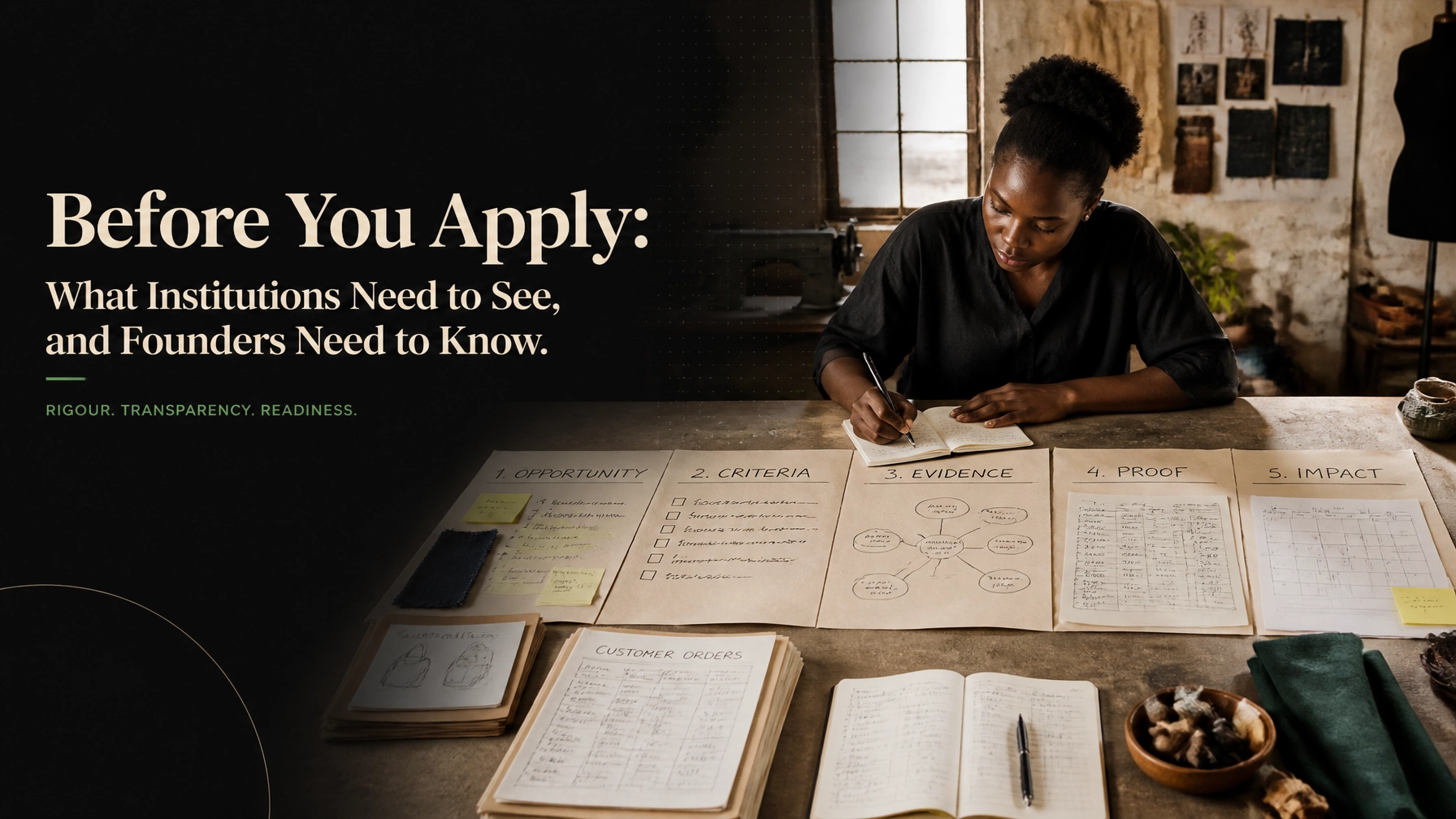
An application is not a rehearsal space for readiness.
It is an evaluation against a particular decision.
That does not mean applying early is always wrong. An early application can help a founder learn what an opportunity requires. But applying without understanding the decision conditions can cost time, attention, money, and confidence.
The useful question is not, “Can I tell a convincing story?”
It is:
What decision is being made, what conditions does it require, and what can I responsibly prove today?
This is the practical space between Potential Is Not Readiness and rejection. A founder may have a strong idea and still lack the evidence required for one particular grant, accelerator, investor, or partnership.
Readiness is not a permanent label. It changes when the evidence changes.
Before improving your pitch, separate fit from readiness.
Fit asks whether the opportunity is meant for a business like yours. Readiness asks whether you can currently meet its conditions and show the required evidence.
Check the opportunity against:
If the fit is wrong, better records will not solve the problem.
A fashion founder applying to a programme limited to agricultural technology may have excellent customer records and still be ineligible. A pre-revenue business applying for financing that requires transaction history may have potential but may not meet that instrument’s conditions.
If fit is plausible but evidence is missing, the next step is different. The founder may need to complete a milestone, improve record-keeping, test demand, or clarify the use of funds before applying.

Words such as traction, capacity, impact, scalability, and sustainability are not evidence. They are categories that need to be translated.
For each criterion, ask:
The answer will vary by opportunity. The following examples are illustrative, not universal.
A grant may require proof of eligibility, a clear project plan, an impact framework, a realistic budget, and the ability to report on activities and results. A statement such as “we support women entrepreneurs” is not the same as a defined target group, baseline information, delivery plan, and reporting method.
An investor may examine customer demand, revenue quality, economics, governance, market size, and the proposed use of capital. “We have many interested customers” is weaker than a documented customer list showing who paid, how often they bought, and what revenue was collected.
An accelerator may prioritise stage, founder-market understanding, learning speed, coachability, and progress since the idea began. At that stage, a founder may not need mature financial reporting, but may need to explain what was tested, what was learned, and what changed as a result.
A commercial partner may care about delivery reliability, product quality, response times, capacity, compliance, and the ability to meet agreed terms. A good product alone may not prove that the founder can supply it consistently.
Public application materials can help founders see this difference. For example, the Techstars application preview shows how an accelerator may ask about the team, customers, market, competition, and progress. It is not a universal template. It is a reminder to examine what a particular programme is actually trying to learn.
Many application problems are not caused by a complete absence of work. They are caused by work that has not yet become a usable record.
Here are some common differences:

This does not mean every founder needs a polished data room before applying. The evidence should be proportionate to the decision.
A very early accelerator may reasonably accept customer interviews, a working prototype, early user behaviour, or a clear record of learning. A funder asking for financial accountability may reasonably require more formal budgets and reporting. A partner considering a large contract may need stronger delivery proof than a customer buying one item.
The question is not whether the evidence looks impressive. It is whether it helps the evaluator make the decision they are responsible for making.
A polished application cannot substitute for missing evidence.
Clear writing helps an evaluator understand your business. It does not turn an untested assumption into a result. Strong branding may show care. It does not prove repeat demand, delivery capacity, or financial control.
Every unanswered question has a cost. If an evaluator cannot tell who the customer is, how revenue was calculated, or what the requested capital will achieve, they must spend more time interpreting the application or carry more uncertainty into the decision.
That does not make uncertainty unacceptable. Early businesses are uncertain by nature. The stronger approach is to name it and bound it.
For example:
A smaller, well-supported ask can also be more coherent than a larger, vague one. If the evidence supports testing one customer segment, improving one production bottleneck, or completing one measurable pilot, the request should reflect that. The size of the request should connect to the next decision or milestone.
Finally, one opportunity’s rejection is not a universal verdict. A rejection may indicate poor fit, missing evidence, a different stage requirement, limited capacity in that funding round, or a decision preference that does not match your business model.
It should be examined before it is interpreted.
This is not an argument that institutions should remove all uncertainty or reduce every application to a checklist.
Programme teams, funders, investors, and partners work under real constraints. They may handle large application volumes, protect confidential information, meet fairness requirements, follow administrative rules, and make decisions with limited time.
Still, an opportunity becomes more useful when it makes several things clear:
For example, “show impact” gives a founder little direction. “Define the people reached, the change expected, the baseline available, and how you will report progress” is more actionable.
Clearer requirements do not guarantee that more applicants will be selected. They help applicants make more informed decisions about whether to apply, what to prepare, and when to return.
Use this sequence before investing heavily in an application. It is not a scoring system. It is a way to find the decision you are actually preparing for.
What exactly are you applying for?
Is it funding, a programme place, a partnership, procurement access, or something else? What decision will the institution make about your application?
What must already be true?
Check the published requirements for sector, location, stage, legal status, revenue, team, project timing, customer group, or other conditions.
What can you show today?
Gather records such as sales logs, invoices, customer conversations, repeat-order history, delivery records, prototypes, contracts, budgets, team roles, or impact data.
Do not list only what you have done. Note what each record proves.
What are you treating as true without sufficient evidence?
This may include customer demand, pricing, production capacity, market size, repeat purchases, partnership interest, or the expected effect of funding.
Which missing pieces could change the decision?
Not every missing document matters equally. Focus on gaps connected to eligibility, risk, demand, delivery, impact, or use of funds.
What must happen before the gap can be closed?
You may need customer conversations before changing the offer, a prototype before collecting useful feedback, or clean transaction records before making a revenue claim.
What is the smallest meaningful milestone that would create new evidence?
Give it a date, an owner, and a clear result. “Improve traction” is not a milestone. “Record ten paid orders from the target customer group and reconcile the revenue by 30 September” is more useful.
After the milestone, what changed?
Record the result, including an unsuccessful result. A failed test can still clarify what the opportunity requires next.
Does the new evidence change your position for this specific opportunity?
You may now be ready to apply. You may discover that the opportunity is still a poor fit. Or you may need another milestone.

Sometimes the pre-application problem is narrow: an unclear offer, a missing evidence map, a messy customer record, or an undefined next milestone.
A focused external working session may help clarify that immediate problem or improve one existing asset. It does not make a founder institutionally ready, guarantee acceptance, or represent a validated product.
If useful, the public entry choices are:
This is an optional practical companion, separate from institutional evaluation. You can read more in You Don’t Need an Agency. You Need One Hour With Someone Who Fixes Things.
Readiness is opportunity-specific. It improves when relevant evidence changes.
Before applying, do not ask only whether you can make the business sound convincing. Ask what decision is being made, what conditions it requires, and what you can responsibly prove today.
We’re testing this. If your organisation evaluates, funds, accelerates, supports, or partners with founders, Vendoura would welcome a conversation about how you currently distinguish fit from readiness and what information would be useful before an application reaches your team. Contact Vendoura.