

Newsletter Subscribe
Enter your email address below and subscribe to our newsletter
Enter your email address below and subscribe to our newsletter

Creative entrepreneurship in Africa

Category: WORLDS
A founder can be running a real business and still be invisible to the institutions that claim to support businesses.
In her own world, the evidence is everywhere. Customers message her on WhatsApp. She confirms orders, negotiates delivery, reorders materials, follows up on payments and responds to complaints. Her phone is her sales ledger. Her memory holds the price of fabric, the name of a reliable supplier and the customer who always pays late. Her business moves through trust, repetition and personal relationships.
Then she enters the institutional world.
There is an application portal, a deadline, a scoring sheet and a list of required documents. The form asks for reconciled records, unit economics, delivery history, governance details and a plan linked to measurable outcomes. The business that felt active and visible a moment ago now appears incomplete.
She has not disappeared from the economy. She is missing from the formal system’s field of vision.
That distinction matters.
The founder’s world is relational, oral and fast-moving. It is built through WhatsApp groups, Instagram DMs, market stalls, referrals and repeat customers. Information travels quickly because people already know one another. Trust often substitutes for paperwork.
A customer may place an order through a voice note. A supplier may hold stock because the founder has bought from them for years. A delivery may be confirmed with a photograph and a short message. A price may be agreed in a conversation rather than a contract.
This world is not necessarily disorganised. It is organised around relationships instead of documents.
The institutional world answers a different set of questions. Can this business be verified? Can its financial position be understood? Can it deliver what it proposes? Who is responsible for decisions? What happens if something goes wrong? What evidence supports the claims in the application?
Its language is written, documentary and comparative. It relies on forms, records, eligibility rules, compliance checks, budgets and scored criteria.
Neither language is inherently wrong. The problem is that they do not automatically translate into each other.

A founder may possess strong evidence of demand but have no way to present it as a customer record. She may know that a product sells consistently but not have the cost history needed to demonstrate its margin. She may have completed dozens of orders but lack delivery documentation that an external reviewer can verify.
The institutional system does not see the full operation. It sees what has been submitted.
An application is a snapshot. A business is a living operation.
The form may ask for annual revenue, but not how revenue changes by product or season. It may ask how many customers the business serves, but not how many return. It may ask for a delivery plan, but not what the founder has already learned from fulfilling orders under pressure.
This is not always because institutions do not care about the day-to-day reality. Formal systems need a consistent way to compare applicants, manage risk and account for decisions. But the process compresses a complex business into a small set of fields.
What does not fit the fields can become invisible.
From the founder’s side, the process can feel distant and unpredictable. The criteria are often most visible at the point of rejection.
A founder may receive a message saying that her application was not successful, without understanding whether the problem was eligibility, financial evidence, business maturity, the quality of the proposal or the fit between the opportunity and her current stage.
Without usable feedback, rejection produces very little learning. The founder may apply again with a stronger story but the same missing evidence.
This is one reason institutions can appear arbitrary even when they are following an internal process. The logic exists, but it is not visible early enough for the founder to work with it.
Some founders have access to people who can interpret a call for applications, review financial records or explain what a programme manager means by “capacity.” Others rely on friends, scattered online advice or trial and error.
Accountants, mentors, experienced operators and intermediaries can help translate between the two worlds. But their support is not evenly distributed. It may be too expensive, too far away or available only after a founder has already reached a certain level of visibility.
The result is a familiar contradiction: institutions say they cannot find enough qualified applicants, while promising founders say opportunities are inaccessible.
Both statements can be true at once.
That is not necessarily a talent problem. It is a translation problem.
A bridge between informal businesses and formal institutions would not require founders to abandon the networks that sustain them. It would make the work already happening easier to read, test and improve.
It would begin with three practical elements.
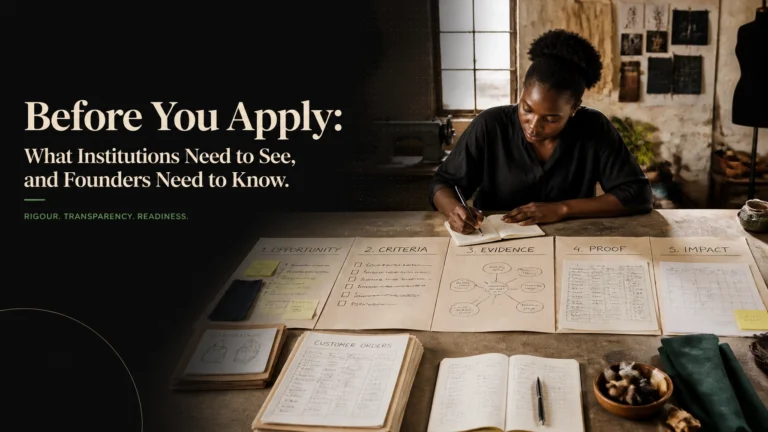
Revenue, costs, customers, orders, inventory and delivery should exist in a form that can be reviewed later.
This does not always mean audited accounts or sophisticated software. It may begin with a consistent record of sales and expenses, a separate view of personal and business money, supplier receipts, order histories and delivery confirmations.
The important change is not that the founder suddenly becomes “formal.” It is that activity becomes visible beyond memory and conversation.
Research on the informal–formal divide in financial services repeatedly points to documentation, records and information asymmetry as barriers between small businesses and formal institutions. The same problem appears in grants, procurement, partnerships and other opportunities: not only in lending. See the Research ICT Africa report on informality and financial inclusion and the UNCDF discussion of the informal–formal divide.
The useful question is not simply, “Is this founder ready?”
It is:
What must be true for this particular business to qualify for this particular opportunity?
A business may be ready to fulfil a large customer order but not ready for a grant requiring detailed impact reporting. It may have enough demand to justify equipment but not enough financial history for a conventional loan. It may be strong operationally but missing registration documents required for procurement.
Readiness is not a permanent label. It depends on the opportunity and the evidence that opportunity requires.
When an application fails, the founder should be able to understand what evidence would have changed the decision.
That does not mean every applicant receives a long explanation or that every rejection is negotiable. It means the system distinguishes between different kinds of gaps:
Without that distinction, founders respond to every rejection by adding more ambition to the next application. What may be needed instead is a better record, a completed milestone or a different sequence of steps.

A practical bridge can be built in a clear order:
This sequence turns readiness from a vague judgement into something observable.
It also prevents a common mistake: pursuing opportunities before the business has built the evidence those opportunities depend on. A founder may apply for a large production contract before documenting fulfilment capacity. She may seek investment before understanding contribution margin. She may enter a partnership conversation before clarifying who owns which responsibility.
The problem is not that she is too ambitious. The problem is that the sequence between potential and proof has been skipped.
For founders, the ceiling of the network around them can become the ceiling of the business. If the people in their circles cannot explain institutional criteria, prepare records or provide credible feedback, access to opportunity depends on proximity rather than potential.
For institutions, shallow pipelines become self-reinforcing. If applications are the only way to identify qualified businesses, institutions will mostly find businesses already familiar with applications. “There are not enough qualified applicants” can then become a condition produced by the selection system itself.
For the wider ecosystem, economic activity remains informal not always because founders prefer informality, but because there is no practical route from everyday proof to institutionally legible evidence.

The gap also affects the quality of institutional decisions. When the evidence is thin, institutions may rely on proxies: polished writing, professional design, previous programme participation or the confidence to navigate a portal. Those signals can be easier to recognise than actual operating ability.
A business that is good at applications is not automatically good at delivery. A business that is poor at applications is not automatically unready.
The informal and institutional worlds do not need to become the same.
WhatsApp will remain important. Personal referrals will remain part of how customers and suppliers make decisions. Market relationships will continue to carry information that no form can capture fully.
Institutions will still need written criteria, documentation and accountable decisions.
The missing layer sits between them.
It translates informal business activity into evidence institutions can read. It translates institutional criteria into milestones founders can actually work toward. It creates feedback before the stakes are highest, so a rejected application can become a diagnosis rather than a dead end.
That bridge is not more inspiration. It is a record, a question, a sequence and a feedback loop.
Vendoura is exploring how founders and institutions communicate readiness across different markets. If you are a programme manager or ecosystem builder, you can share how readiness is: or is not: communicated in your market at research@vendoura.com.
The question is not whether the two worlds can be made identical. It is whether the evidence already being created in one world can finally travel to the other.