

Newsletter Subscribe
Enter your email address below and subscribe to our newsletter
Enter your email address below and subscribe to our newsletter

Creative entrepreneurship in Africa

Two founders can have comparable talent, comparable products and comparable ambition. One gets through institutional evaluation. The other does not.
The difference is rarely the idea.
It is usually what each founder can prove about the business at the moment of evaluation.
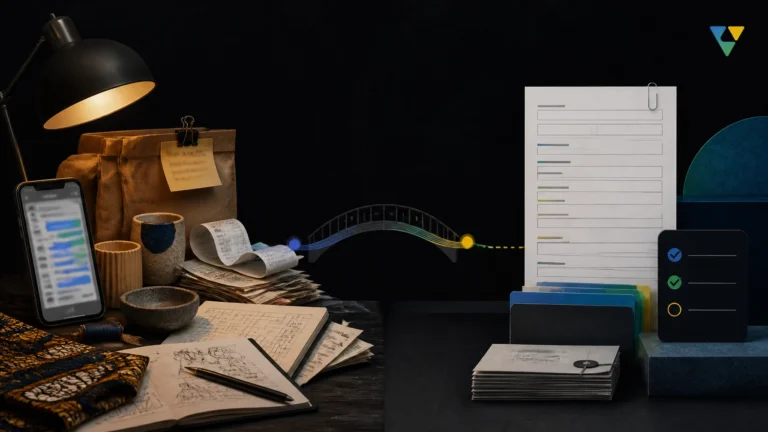
One founder can explain sales, costs, customers and delivery history from organised records. The other has the same information scattered across WhatsApp messages, bank alerts, memory and loose receipts.
One can show why the requested support fits the business’s current state. The other is asking for scale before proving that the underlying model works.
This is not a personality trait. It is a set of practices.
As explained in Potential Is Not Readiness: Why Promising Founders Still Fail Institutional Evaluation, institutions evaluate what can be responsibly assessed now: not only what a founder might become later.
The founder who gets through evaluation has learned to make the business verifiable.
The founder who gets through does not need to be an accountant. They do need to reconcile sales, costs and cash regularly.
When asked, “What is your margin?” they do not estimate from the selling price and the cost of materials alone. They understand the cost of producing, packaging, delivering and, where relevant, marketing the product.
They can distinguish:
The founder who says, “Let me check my phone,” is losing ground to the founder who can answer immediately and show the record behind the answer.
That record might be a spreadsheet, a notebook or a simple bookkeeping app. The tool matters less than the habit. Each week, record:
Do this before an application opens. An application should not be the first time the business attempts to calculate its own economics.

Institutional evaluation often comes down to a simple question: can this founder account for money?
A separate business bank account is useful, but it is not the only way to begin. A small business can create separation with a dedicated wallet, a notebook, a spreadsheet or clearly labelled transaction categories.
What matters is that business money is not mixed invisibly with rent, food, personal transfers and unrelated spending.
A basic weekly record might include:
| Category | Amount | Evidence |
|---|---|---|
| Customer payment | : | Transfer alert or receipt |
| Materials | : | Supplier receipt |
| Delivery | : | Dispatch record |
| Operating expense | : | Receipt or note |
| Founder withdrawal | : | Recorded separately |
This separation does two things.
First, it shows what the business actually earns and costs. Second, it shows that the founder can manage funds without relying on memory.
A founder may still operate from a small room, use informal suppliers or manage the business alone. None of those conditions automatically prevent readiness. The problem is not informality. The problem is untraceability.
“I have customers” is a statement.
“I have a customer record showing orders, dates, values and repeat purchases” is evidence.
A founder preparing for evaluation should be able to assemble a basic demand record from existing activity. It could include:
The purpose is not to create an impressive-looking folder. It is to make the pattern visible.
A social media comment shows interest. A paid order shows a transaction. A repeat order shows a stronger form of demand. A delivery history shows that demand was converted into fulfilment.
These are different signals and should not be presented as if they mean the same thing.
Before applying, take the last six months of available orders and organise them in one place. Look for what the records can genuinely support:
Do not inflate the story. Let the records define the claim.

The founder who gets through evaluation does not apply to every opportunity simply because it is available.
They ask what the business can use now.
A scale-capital programme may not be the right next step if the founder has not confirmed that each additional sale produces a contribution margin. A corporate partnership may create unnecessary risk if fulfilment still depends on last-minute improvisation. A grant may require outcome tracking that the founder has not yet designed.
The opportunity must match the current state of the business.
Before applying, write down:
The same founder can be ready for one opportunity and unready for another.
A small wholesale order may require proof of production capacity. A grant may require eligibility and impact records. An investor may focus on margins, demand quality and the use of capital. A corporate partner may care most about delivery reliability, quality control and continuity.
The proof must answer the question being asked.

A failed application can be handled in two ways.
The founder can rewrite the same story with stronger language, better graphics and more confidence.
Or the founder can ask what evidence was missing.
The second response is more useful.
If an evaluator says the business lacks financial clarity, the next move is not necessarily a new pitch deck. It may be three months of reconciled records.
If the concern is customer demand, the next move may be a dated order history, repeat-customer list or properly recorded pilot.
If the concern is fulfilment capacity, the founder may need to document the production steps, supplier dependencies, lead times and quality checks.
The question after rejection is:
What would I need to be able to show next time that I cannot show today?
Name the missing evidence. Identify its probable cause. Choose one milestone that can produce it.
That is the practical value of a business MRI: a diagnosis, not a verdict. It separates the visible symptom from the underlying gap and identifies the next move.
The gap often appears in one ordinary application question:
“What is your cost of delivery per order?”
A founder may know the price charged and the cost of materials. But delivery also involves packaging, transport, labour, payment charges, failed deliveries and sometimes the time spent coordinating the order.
The question exposes whether the founder has a cost record or only a price assumption.
Other questions reveal similar gaps:
The application form is not creating these weaknesses. It is making them visible.
The founder who treats the form as a diagnostic starts earlier. They mark every question they cannot answer, separate facts from assumptions and build records before submitting.
That changes the form from a chore into a readiness test.
Start the record before the opportunity appears.
Set aside one fixed time each week to compare sales, expenses, cash received and outstanding payments. Keep the process simple enough to repeat.
Use a physical folder, cloud folder or both. Add:
Name files with dates. Do not wait until the deadline to reconstruct the business from scattered messages.
At minimum, track:
The exact definitions may vary by business. Write down how each number is calculated so it remains consistent.
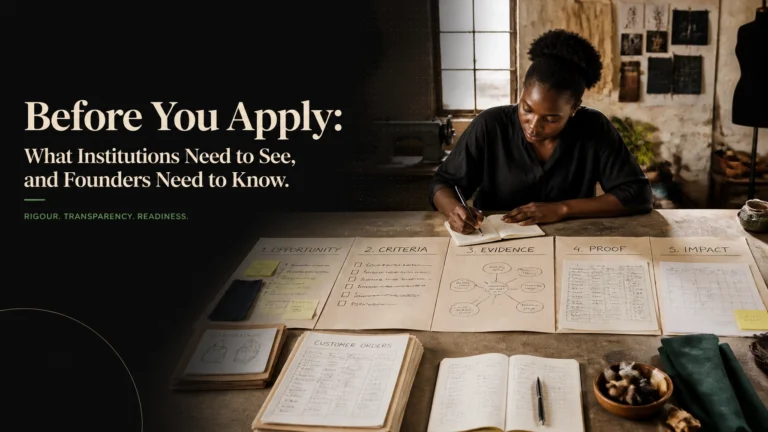
Read the criteria carefully. Build a two-column list: “evidence available” and “evidence missing.”
Then ask whether the missing evidence is a minor documentation issue or a material business gap.
A practical public decision engine can make this work visible:
This prevents planning from becoming private intention. It creates a record of decisions, evidence and outcomes.
If the application fails, ask for feedback where possible. Translate the response into a specific evidence task. Build the record. Reassess the opportunity only after the business state has changed.
Do not submit the same story with more polish if the underlying evidence is unchanged.

Readiness is not a gift. It is built through small, unglamorous, repeatable practices.
The founder who gets through institutional evaluation is not necessarily the founder with the best pitch, the biggest ambition or the most polished presentation.
It is the founder whose business can be checked.
The records may still show risks. The margins may still be modest. The process may still need improvement. But the founder knows what is true, what is assumed, what is missing and what the next resource is meant to change.
That is the difference between saying, “I am building something,” and being able to prove what has been built.
If you are documenting this readiness gap in your own business or research, you can share observations with research@vendoura.com.