
Newsletter Subscribe
Enter your email address below and subscribe to our newsletter
Enter your email address below and subscribe to our newsletter

Creative entrepreneurship in Africa
Africa is currently sitting on a $200 billion creative goldmine. From the intricate beadwork of Nairobi to the high-fashion runways of Lagos and the digital design hubs of Accra, the continent’s cultural output is undisputed. However, there is a structural chasm between "talented creativity" and "industrialized commerce."
While the world consumes African culture, the African creator often remains trapped in a cycle of "survival-mode hustle." We see visually premium products backed by verbally cheap business structures. We see world-class skill coupled with third-class execution.
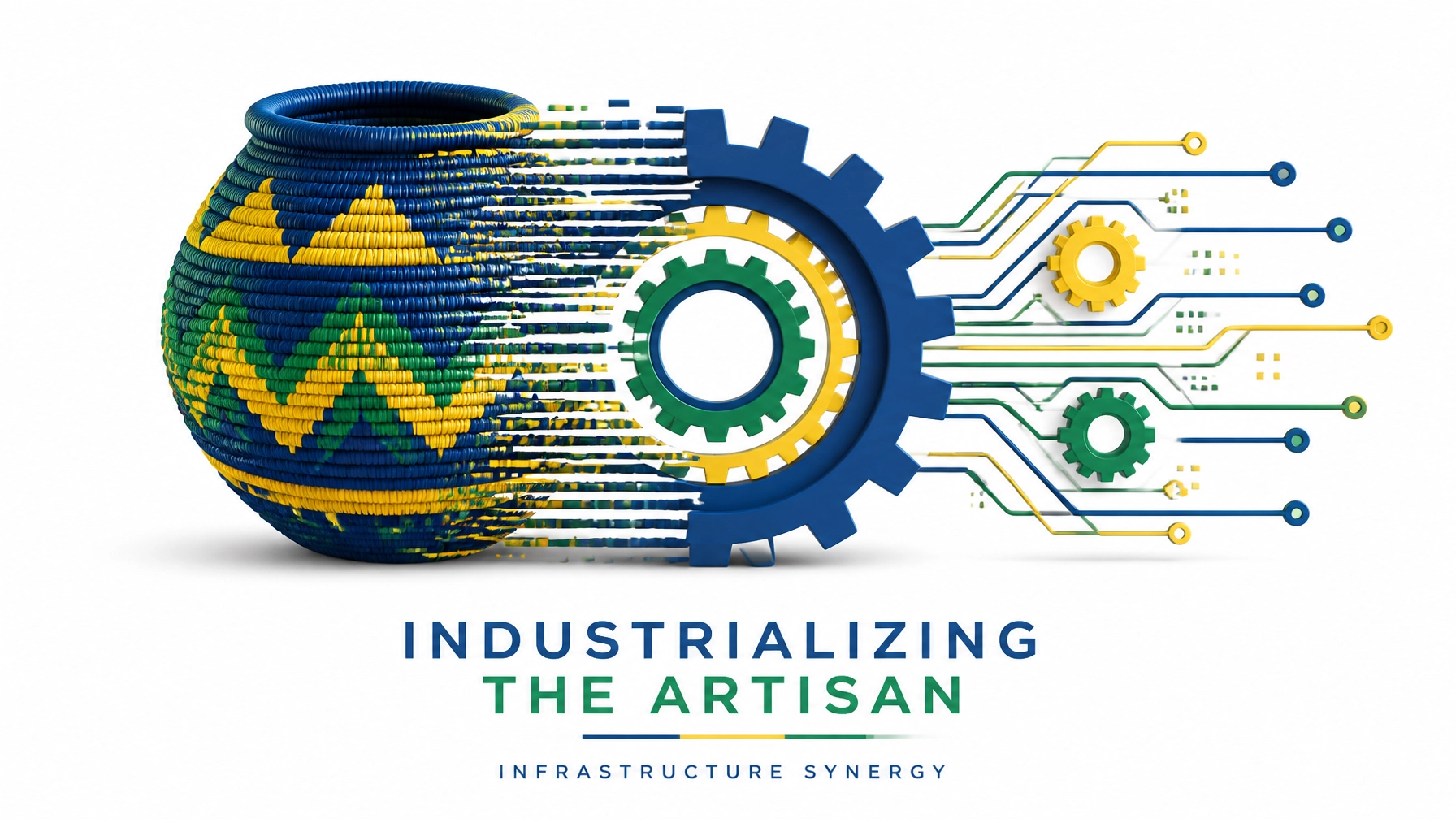
To capture the $200B shift promised by the African Continental Free Trade Area (AfCFTA), we must stop romanticizing the "starving artist" and start industrializing the artisan. This isn’t about losing the "soul" of the craft; it’s about building the "spine" of the business. At vendoura, we call this the transition from Artisan to Architect.
For decades, African creative commerce has been defined by informality. We celebrate "handmade" as a badge of honor, but in the global market, "handmade" often becomes a euphemism for "unstandardized."
Informality is a ceiling. It creates a friction-heavy environment where:
The "survival-mode hustle" is not a lack of effort; it is a lack of an Operating System (OS). Most creative founders are operating with "Founder Intelligence": the idea that their personal talent is the business. This is a fatal misunderstanding. Talent is the fuel; infrastructure is the engine. Without the engine, you are just pouring expensive fuel onto the ground.

Industrializing creativity does not mean mass-producing soulless products. It means standardizing the commerce layer so the creativity can flow without friction.
Under the AfCFTA, the goal is to turn 54 fragmented markets into one 1.4-billion-person trade zone. But trade doesn't happen just because a treaty was signed. Trade happens when a vendor in Kigali can trust the logistics, payments, and quality standards of a supplier in Dakar as easily as if they were in the same street.
We need a unified language for creative goods. This involves adopting universal identifiers (like ISRC for music or standardized sizing and material grading for fashion) and digital metadata. When your product is "standardized," it becomes a liquid asset. It can be listed, tracked, and sold across any store listing without manual intervention.
The $200B shift requires moving from "selling things" to "monetizing IP." Standardizing contracts, licensing agreements, and copyright enforcement across borders allows an African designer to scale their brand through partnerships rather than just physical production. This is how you build a global brand while staying rooted in local excellence.
Creative commerce fails when payments are stuck in "analog" loops. Standardization means integrating into systems like the Pan-African Payment and Settlement System (PAPSS), ensuring that creative enterprises can settle cross-border transactions in local currencies instantly.
At vendoura, we don’t just offer "business tips." We provide the Execution Layer. We are moving the needle from helping "artisans" refine their skills to helping "architects" build systems.
Our approach is rooted in Infrastructure Synergy. This is the realization that business education is useless without the tools to execute, and tools are useless without a community that demands accountability.

When you combine structured learning with commerce infrastructure (like our vendor communities), you create a compounding effect. You reduce the friction of the hustle and replace it with the discipline of growth.
The vendoura business execution model is designed to fix specific vendor frustrations. Are you "visually premium but verbally cheap"? That is a brand diagnosis problem. Do you have "inconsistent sales"? That is a customer flow system problem. We identify these invisible blindspots and provide the infrastructure to fix them.
The AfCFTA is the largest free trade area in the world by the number of participating countries. It is the bridge to global scale. However, the bridge is only useful if your business is "load-bearing."
Most informal creative businesses would collapse under the weight of a 1,000-unit international order. They lack the repeatability and the system-focused operations to handle true scale. Industrializing creativity is about making your business load-bearing.

We are witnessing a shift in the global economy where "creative" is becoming the new "industrial." Software, design, fashion, and content are the new steel and oil. Africa is the primary producer of this raw material. The question is: will we continue to export the raw material (talent) or will we build the refineries (standardized businesses) to capture the value?
The biggest barrier to growth isn't a lack of capital; it's an identity crisis.
A Skill-Focused Founder asks: "How can I make a better product?"
A System-Focused Architect asks: "How can I build a system that produces a better product every time, without my direct supervision?"
One leads to a job you can't quit; the other leads to an enterprise you can scale. vendoura is the operating system for the latter. We are building a community of creative architects who understand that standardization is the ultimate form of creative freedom.
By standardizing your operations, you free your mind to focus on the next $200B idea, rather than the next $20 shipping headache.
Business doesn't fail because of a lack of motivation. It fails because of a lack of an OS. If you are tired of "survival-mode hustle" and are ready to build a structured, scalable, and sustainable creative enterprise, it’s time to move beyond the informal.
The global market is looking for African creativity that is standardized, predictable, and professional. The infrastructure is here. The synergy is waiting.
Are you ready to stop being an artisan and start being an architect?
Don't just read about the $200B shift. Become the infrastructure that drives it.
Apply for the Vendoura Sprint.
Our intensive execution program is designed for serious creative founders who want to implement the systems, commerce tools, and growth discipline required to scale in the new African creative economy.
Contact us today to join the next cohort of creative architects or explore our business communities to find your next strategic partner.