
Newsletter Subscribe
Enter your email address below and subscribe to our newsletter
Enter your email address below and subscribe to our newsletter

Creative entrepreneurship in Africa

Most jewelry designers are stuck in a cycle of "hope marketing." They post a reel, pray the algorithm catches it, and spend their days answering "How much?" in Instagram DMs only to be ghosted.
Aria was no different. She was a talented artisan making custom brass and gemstone pieces. Her work was beautiful, but her business was a ghost town. She was working 60 hours a week to make maybe $400 in profit. She was technically skilled but commercially invisible.
Then she entered the vendoura 14-day sprint.
Two weeks later, she didn't just have more followers. She had five corporate contracts worth more than her previous six months of revenue combined.
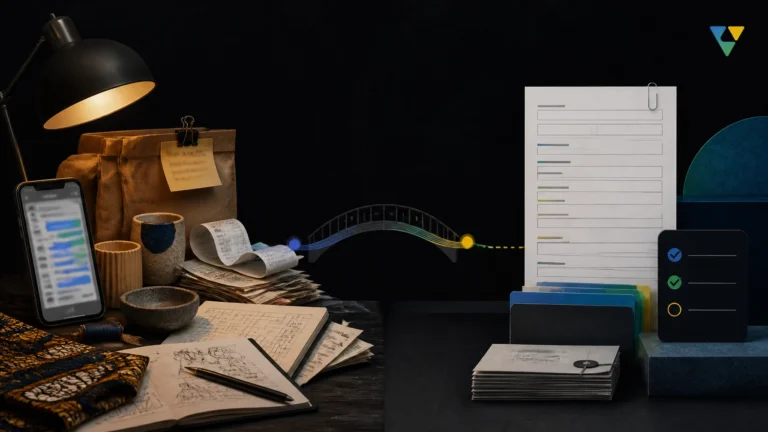
This wasn't luck. It was an operating system. If you want to know how to get clients as a jewelry business without spending a dime on ads, you need to stop acting like an artisan and start acting like an architect.
Before the sprint, Aria thought her problem was "visibility." She thought if she just had more followers, she’d have more sales.
When she ran her first diagnostic with Vera, our AI Revenue Coach, the truth was much sharper. Vera didn't ask about her hashtags. Vera asked: "Who has the pre-allocated budget to buy 50 of your pieces at once without asking for a discount?"
Aria realized she was selling "pretty things" to individuals who saw her work as a luxury they couldn't afford. She wasn't selling a solution; she was selling a craft. To learn how to turn skills into income, you must first realize that people don't pay for your time or your talent: they pay for the value you create in their world.
For a jewelry business, that value isn't just "looking good." It’s "solving a gifting problem for a marketing manager" or "providing a sustainable branding asset for a luxury hotel."
The first step of the vendoura client acquisition system is the Diagnostic.
Aria had to face the facts. Her "business" was actually a series of random tasks. She had no documented process for outreach, no line sheet, and no clear B2B offer.
Vera’s diagnostic revealed a massive blindspot: Aria was treating her business like a hobby that occasionally made money. She was told: Prove fast or lose the business spirit.

The diagnostic forced her to answer one question: “If you had to make $5,000 in 14 days or your business closes forever, what is the one task that actually moves the needle?”
The answer wasn't "post a reel." It was "Secure 5 pitch meetings with corporate HR departments for their employee appreciation gifts."
In vendoura, we don't do to-do lists. We do Commits.
A Commit is a high-stakes promise. Aria committed to one thing: Building a B2B Line Sheet and pitching it to 20 local corporate marketing heads.
The stakes were real. At vendoura, we don’t play. If you miss two deadlines, your account is terminated and your access is revoked. This isn't "just another tool" for organization; it's a high-stakes environment where execution is the only currency.
Aria didn't need to know how to get clients as a beginner by reading more blogs. She needed to commit to the uncomfortable work of direct outreach.
This is where most "online courses" fail. They give you information but no accountability. At vendoura, you don't just "mark a task as done." You must Prove it.
Aria had to upload evidence: her sent emails, her line sheet, and her responses. These weren't checked by a bot; they were reviewed by a human Founder Manager.

When Aria tried to "busy-work" her way through the sprint, her Founder Manager called her out. "This line sheet looks like a catalog for individuals. Redo it for a corporate buyer who cares about lead times and bulk pricing."
That intervention is the difference between a "fail" and a "sale." Aria learned how to close your first client by presenting her jewelry as a professional trade asset, not a handmade curiosity.
By day 10, the responses started coming in.
Aria didn't just make her first sale in the B2B space; she closed 5 clients in 4 days.
But the final step of the vendoura formula isn't just celebrating the win. It’s Evolve. Aria had to document exactly how she found those leads and what she said to close them.
She wasn't an artisan anymore. She was building her Documented OS (Operating System). She was becoming an Architect. Now, when she wants to scale, she doesn't "work harder." She runs the "Corporate Acquisition Machine" she built during those 14 days.
If you are a jewelry designer: or any creative founder: stuck in the "Instagram trap," you need to stop looking for more "tips." You need a business intervention.
You don't need capital. You don't need ads. You need Infrastructure Synergy. You need an environment where your ideas are hatched into empires through disciplined execution.
Stop asking how to sell handmade products online without ads and start asking: "What is the documented system I am building today that will pay me for the next ten years?"
If you’re frustrated by low sales, look at your calendar. How much of your time was spent on making (Artisan) versus building the machine (Architect)?
If you spend 90% of your time making, you don't have a business. You have a job with a very mean boss (yourself).
Don't wait for a "better time" to start. Capital follows clarity.
Your Task:
Identify 5 local businesses that have a "brand identity" that matches your aesthetic. Spend 20 minutes finding the name of their Marketing Manager or HR Director.
That is your first move toward hatching your idea into an empire.
Aria’s transformation from a struggling artisan to a B2B powerhouse didn't happen because she got better at making jewelry. It happened because she committed to a system that didn't allow her to hide behind her "creativity."
Are you ready to be an Architect?
Join the Vendoura Waitlist and start your own 14-day sprint.