


Newsletter Subscribe
Enter your email address below and subscribe to our newsletter
Enter your email address below and subscribe to our newsletter

Creative entrepreneurship in Africa
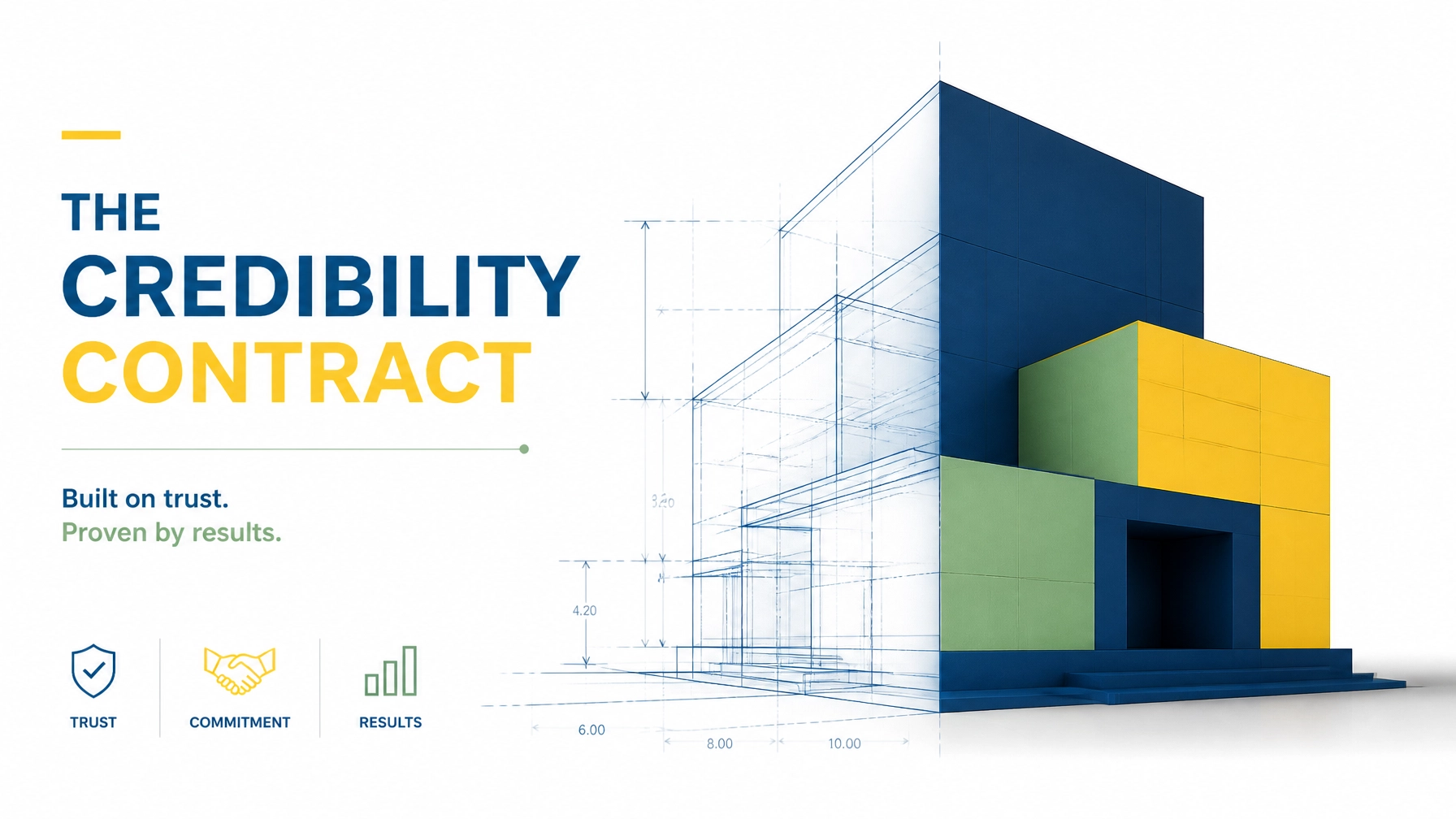
Talent gets you noticed. Structure gets you signed.
Institutional partners don’t “fall in love” with a founder’s gift. They underwrite operational certainty: predictable delivery, defensible governance, auditable numbers, and repeatable outcomes. In other words: institutional credibility.
This is the real gap in the creative economy: many founders are exceptional creators but fragile operators. Their output looks premium, but their business behaves like improvisation.
This post exposes the silent filter that decides whether a partner takes you seriously:
The Credibility Contract: the unspoken agreement that your business can be trusted as a system, not just admired as a talent.
And here’s the reframing most serious founders eventually discover:
Business design is the ultimate creative act.
Because designing a business means designing behavior, how value is produced, repeated, measured, governed, and scaled.
Most creative founders think partnerships are won by:
Institutional partners are looking for something else:
If the answer is unclear, you don’t look “early-stage.” You look unreliable.
That’s the core failure mode: premium craft trapped in survival-mode hustle.
In institutional logic, talent is often treated as key-person risk: if the value lives inside one person’s head, the partner is exposed.
Structure reduces key-person risk. It makes delivery consistent. It makes outcomes legible and auditable. It turns “a gifted person” into “a partnerable institution.”
This is why institutional players consistently prioritize business structure over raw creative brilliance.
External references that reflect this risk-and-structure bias:
Institutions don’t buy your hustle. They buy your machine.
They’re underwriting four things:
If you can’t show those signals, you don’t have an “institutional credibility” problem.
You have a business design problem.

The credibility contract is the silent promise your business makes to any serious partner:
If your business cannot consistently keep these promises, institutional partners will treat you like a high-quality vendor, never a strategic partner.
And strategic partnerships are where distribution, capital, and compounding live.
Most founders use the word synergy when they mean chemistry.
Institutions mean something else:
Synergy is system-to-system compatibility.
It is not vibes. It is not “we love your brand.”
It is “our process plugs into your process without chaos.”
No structure means:
That friction kills synergy before it starts.
At vendoura, we call the alternative Infrastructure Synergy: the compounding effect of combining:
Not as separate “programs”, but as one operating system.
Craft is creativity applied to a product.
Business design is creativity applied to a system.
A system is what determines:
If you want to be taken seriously by institutions, don’t just design your packaging.
Design your operations.
This is the “Architect” shift vendoura is obsessed with: moving founders from skill-first identity to system-first identity.
If you want a parallel example from the broader creative ecosystem, read how Victor Fatanmi’s journey is framed through the Artisan → Architect transition on the vendoura blog:
https://www.venhub.vendoura.com/the-morning-spark-from-artisan-to-architect-the-victor-fatanmi-story/
Institutions want to see repeatable operations:
Your best product is not your best seller.
Your best product is your most repeatable outcome.
They want execution that is visible:
Hard work is not accountability.
Accountability is trackable execution.
They want value that doesn’t disappear if the founder disappears:
The institutional question is simple:
“If you’re unavailable for 90 days, what still works?”
They avoid mess because mess creates liability:
This is not bureaucracy.
This is touch-safety.
Not “tips.” Not motivation. Infrastructure.
Here’s the stack that turns talent into institutional credibility:

If your offer changes every week, institutions read that as instability: not creativity.
A partner cannot scale what they cannot measure.
Institutions don’t pay for “effort.” They pay for reliability.
A business without governance is a brand with no brakes.
This is where structure turns into leverage.
Many accelerators teach. Then founders go back to survival-mode hustle.
vendoura is built as the Execution Layer: the operating system where founders execute with structure, not just learn. We prioritize Infrastructure Synergy: education + tools + commerce infrastructure + accountability + community: so results compound instead of resetting every month.
To see how vendoura frames infrastructure as the “backend” creators can plug into, read:
https://www.venhub.vendoura.com/the-ecosystem-engine-why-vendoura-is-the-backend-for-africas-best-creative-communities/
And to understand our infrastructure positioning more broadly:
https://www.venhub.vendoura.com/award-winning-infrastructure-why-vendoura-is-the-ultimate-full-stack-operating-system-for-creative-founders/
Explore the ecosystem:
Institutional partners don’t partner with “potential.” They partner with designed inevitability.
That requires an identity upgrade:
Your brand is not your color palette.
Your brand is your reliability under pressure.
If you’re an institutional partner reading this, here’s the diagnostic you can run on any creative brand.
If you’re a founder, here’s what to build before you pitch.
In the next 14 days:
If you can’t do these, you don’t need a bigger audience.
You need business design.
If you want high-tier partnerships, don’t “pitch harder.” Build the structure that makes the pitch obvious.
Apply for Vendoura Sprint: the execution-focused path inside the vendoura creative business accelerator where we install the Structure Stack, enforce accountability, and build Infrastructure Synergy around your business.
Start here: