
Newsletter Subscribe
Enter your email address below and subscribe to our newsletter
Enter your email address below and subscribe to our newsletter

Creative entrepreneurship in Africa
Africa’s creative economy is at a breaking point. On one side, we have an explosion of talent: fashion designers, jewelry makers, and digital artists who are globally relevant but locally fragile. On the other side, we have a $200 billion opportunity projected by 2030, currently being held back by a single, pervasive friction point: informality.
Most creative founders in Africa are trapped in the "Artisan’s Paradox." They are technically brilliant at their craft but operate within a "survival-mode hustle" that lacks the structural integrity to scale. They are building on sand.
The transition from a fragmented, informal market to structured creative commerce is not just a trend; it is the necessary evolution for any founder who wants to move from being an artisan to becoming a business architect.
The data is clarifying. Africa’s creative industries are currently valued at approximately $4.2–$5 billion annually. Yet, UNESCO and Brookings suggest that with the right structures, this could grow tenfold. The roadblock isn't a lack of talent or demand: it’s the "informality gap."
In Kenya, for example, an estimated 84% of creative enterprises remain unregistered. This is more than just a paperwork issue; it is a systemic failure. Informality translates to:
At vendoura, we recognize that most accelerators fail because they offer "Founder Intelligence" (teaching people how to think) without providing the "Execution Layer" (giving them the tools to act).
The creative founder of the future is not an artisan; they are an architect. An artisan focuses on the skill; an architect focuses on the system.

Scaling an artisan business in Africa requires more than just "tips" or "growth hacks." It requires Infrastructure Synergy. This is the core philosophy behind vendoura for creatives. We believe that growth is the byproduct of reducing friction, and friction is reduced when three specific layers overlap:
Most creative founders have "visually premium but verbally cheap" brands. They look great on Instagram but fail the moment a customer asks for an invoice or a structured return policy. This is because they are operating without a Business Operating System (OS).
Structured creative commerce is about building that OS. It’s about moving away from the "hustle" and toward "repeatability."

When a creative founder joins a creative business accelerator like vendoura, they aren't just learning; they are installing infrastructure. They are setting up store listings that work while they sleep, joining specialized groups that provide market access, and utilizing execution frameworks that turn a one-off sale into a sustainable customer flow.
We need to reframe "hustle." In the informal creative economy, hustle is often praised. But in reality, hustle is a silent signal of system failure. If you have to manually handle every customer inquiry, payment confirmation, and delivery update via a fragmented thread of DMs, you are not a CEO; you are a high-end clerk for your own brand.
This manual friction is why most creative businesses in Africa plateau after 18 months. The founder runs out of time before the business runs out of potential.

Structured creative commerce fixes this by automating the "low-value" execution tasks. This allows the founder to focus on what actually drives value: brand diagnosis, pricing psychology, and product innovation.
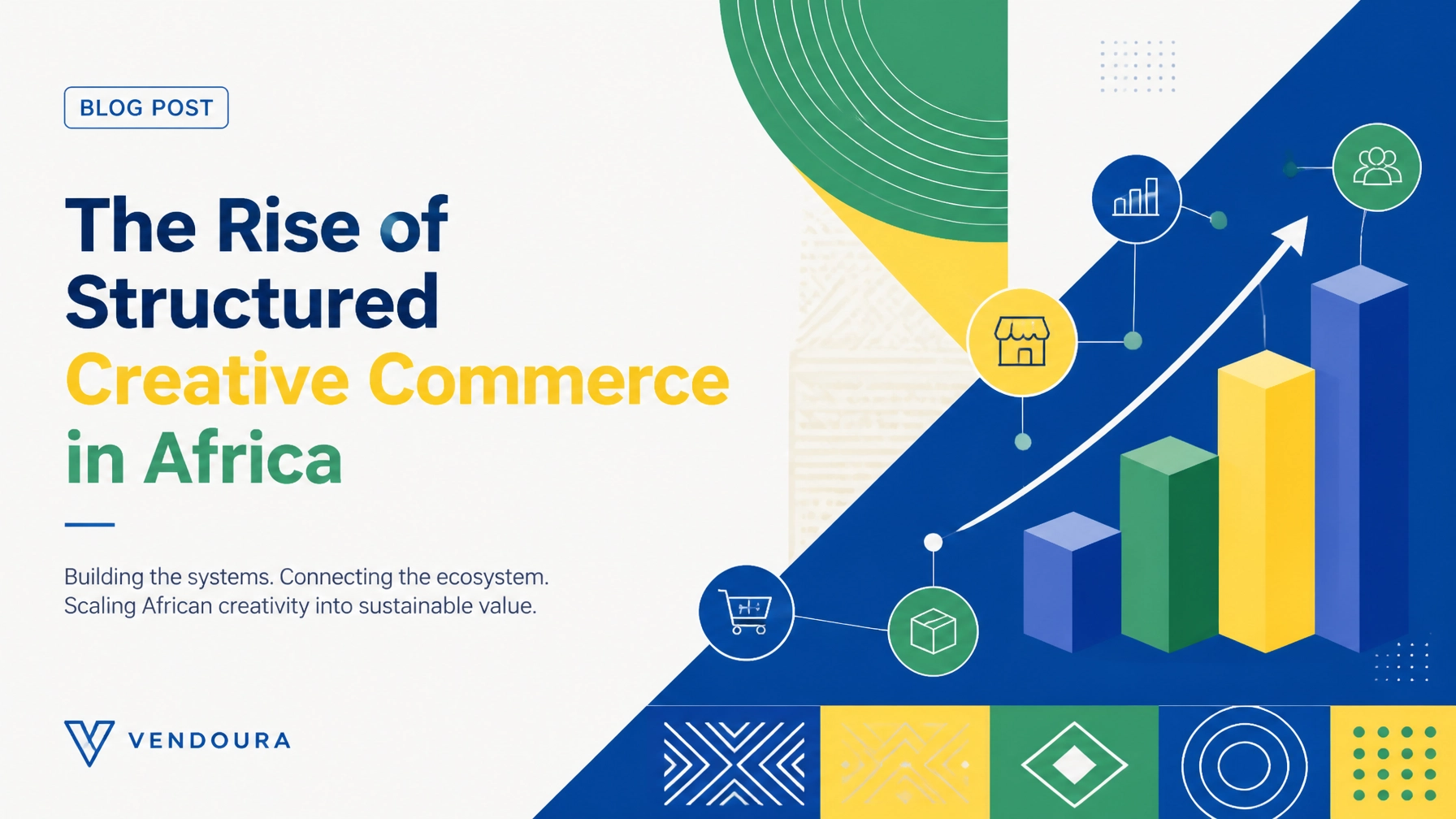
The rise of structured creative commerce in Africa is being driven by platforms that act as the "Execution Layer." Vendoura is designed for the serious creative founder: the one who is tired of the survival-mode loop and is ready to build a structured, scalable, and sustainable enterprise.
We are moving the needle from "Artisan Scaling" to "Architect Building." By combining business education with practical commerce tools and a collaborative growth ecosystem, we are helping founders reduce the friction of the African market.
If your creative business feels like a series of "unconnected sprints" rather than a "steady marathon," it’s not because you lack talent. It’s because you lack infrastructure.
Don't just learn how to build a business: execute it with the right infrastructure. Join a community of founders who are moving from informal hustle to structured growth.
Apply for the next Vendoura Sprint today.